Key Takeaways
(See full list at the top of this article)
You've probably been there. You meet someone, you both happen to be Scorpios, and someone at the party says, "Oh wow, two Scorpios — that's either going to be incredibly intense or a total disaster." And everyone nods like that's an actual insight.
It isn't.
Sun sign compatibility is astrology's version of judging a book by its cover — and not even the whole cover, just the font. The couples I've watched struggle the most are often ones who checked every sun sign compatibility box. And the ones who've built something genuinely lasting? Their charts are sometimes a mess of squares and oppositions that any pop astrology article would call red flags.
Here's what's actually going on — and why synastry, done properly, is one of the most honest tools for understanding relationship dynamics you'll find.
Why 'We're Both Libras So We Should Work' Is Not Compatibility
Sun signs represent roughly two hours of your entire birth chart. They describe your core identity, yes, but identity is only one ingredient in how two people actually function together.
Think about it this way. You know people with the same sun sign as you who you'd never date in a million years — and people with "incompatible" signs you felt immediately connected to. That's not a coincidence, and it's not an exception to the rule. It's evidence that the rule was always incomplete.
Sun sign compatibility charts are built on the theory of elemental harmony: fire signs go with air signs, earth signs go with water signs, and so on. There's some truth in there — elemental energy does shape how people communicate and what they value. But two people with harmonious sun signs can still have Venus placements that create completely different expectations around affection, Moon signs that make emotional connection feel impossible, or Saturn overlays that generate chronic low-grade friction neither of them can name.
And honestly? The couples who rely on sun sign compatibility as their primary data point often have the hardest time understanding why things feel off when they do. Because they've been told it should work.
What Synastry Actually Is (And What It Isn't)
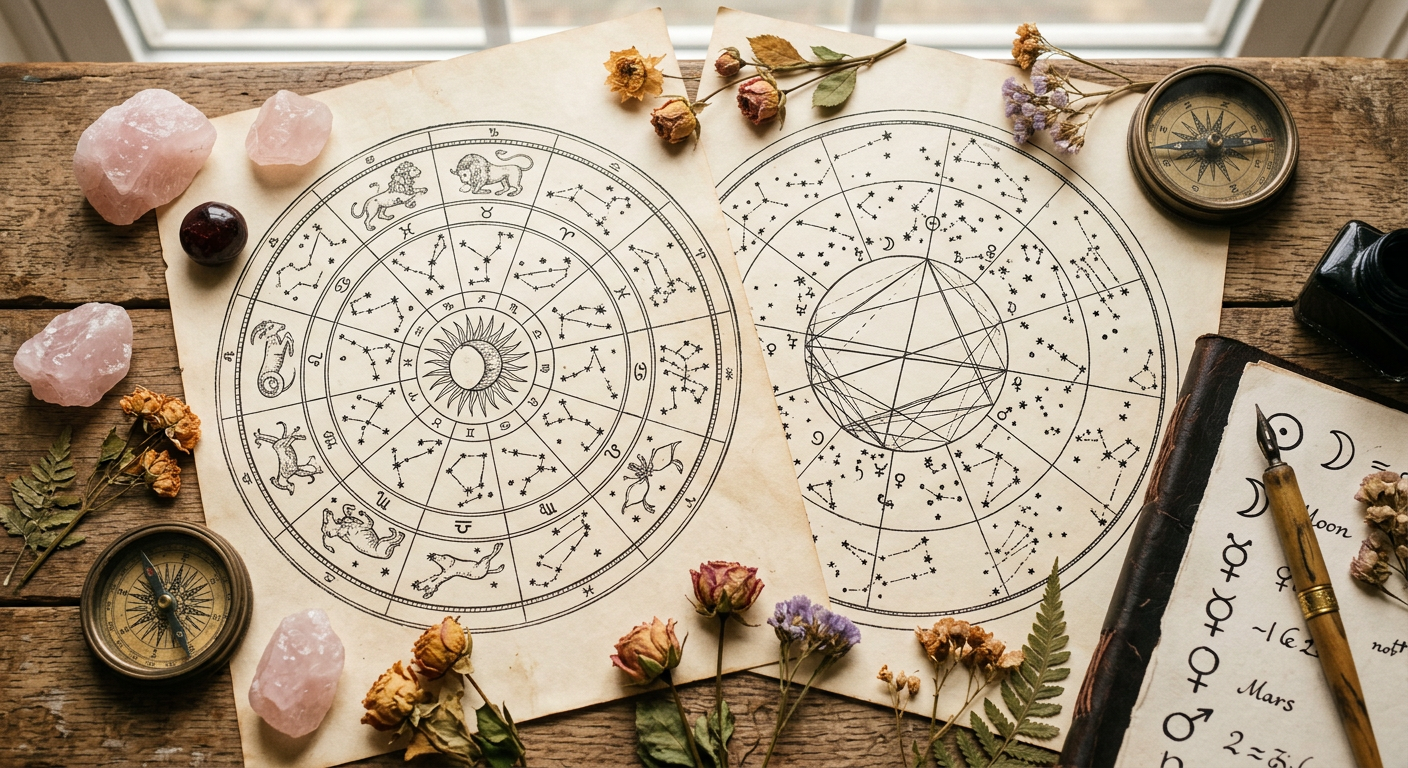
Synastry is the practice of overlaying two birth charts on top of each other and reading the relationships between the planets in both charts. Not just the sun. Every planet — Venus, Mars, the Moon, Saturn, Jupiter, Mercury, the Ascendant — all of it.
When your Venus sits at 14° Taurus and your partner's Mars sits at 16° Taurus, that's a Venus-Mars conjunction. That aspect doesn't care what your sun signs are. It creates its own dynamic: magnetic attraction, physical chemistry, an almost instinctive pull toward each other. Synastry reads those cross-chart aspects and maps out the actual architecture of the relationship.
What synastry is not is a compatibility score. It's not a pass/fail system. I think this is the most important reframe for anyone coming to it fresh — synastry describes the nature of a connection, not its worth. A chart full of trines and sextiles can produce a relationship that's comfortable but stagnant. A chart full of squares and oppositions can produce a relationship that's challenging but transformative and deeply bonded.
The best synastry readers I've encountered treat it like a relationship map, not a verdict. (And if someone's promising you a verdict, that's your cue to find a different reader.)
The Placements That Actually Determine Relationship Dynamics
Here's where it gets genuinely useful. These are the layers that matter most — the ones that explain the chemistry, the emotional safety, the long-term friction, and whether two people fundamentally get each other.
Venus-Mars Aspects: The Chemistry Layer
Venus represents how we give and receive love, what we find beautiful, how we attract and want to be attracted. Mars represents how we pursue, how we assert ourselves, what drives us — including physical desire.
When someone's Venus aspects your Mars (or vice versa), that's the astrology behind "I don't know what it is, I just feel drawn to them." Venus-Mars conjunctions, trines, and sextiles between two charts create natural, almost effortless attraction. The Venus person often feels adored; the Mars person feels inspired and pursued in the right direction.
Squares and oppositions between Venus and Mars are trickier. They still create intense attraction — sometimes even more intense — but there's friction in how that attraction expresses itself. The Mars person might push too hard; the Venus person might feel overwhelmed. Or the attraction is undeniable but the timing is always slightly off.
I've seen couples with Venus-Mars squares who describe their relationship as "electric but exhausting" — and that's almost textbook for this aspect. The charge is real. The effort required to channel it well is also real. You can read more about how your Venus sign shapes attraction style — it gives important context for reading your own Venus placements before you look at synastry.
Moon Aspects: The Emotional Safety Layer
This is the one most people underestimate. The Moon in astrology rules your inner world — your emotional needs, your instinctive reactions, what makes you feel safe or threatened. In synastry, Moon aspects between two charts determine whether two people feel emotionally at home with each other.
Moon conjunct Moon (two people with the same Moon sign) creates deep emotional resonance. You understand each other's moods almost intuitively. You don't have to explain why a certain situation makes you anxious or why you need space — the other person just knows.
Moon-Venus aspects between charts create warmth and tenderness. The Venus person makes the Moon person feel cherished; the Moon person makes the Venus person feel emotionally nourished.
But Moon-Saturn aspects — even soft ones — introduce a complexity. The Moon person can feel criticized or emotionally restricted by the Saturn person, often without the Saturn person meaning to. If you've ever been in a relationship where you felt like you had to manage your emotions carefully around someone, there's a decent chance there was a Moon-Saturn aspect in play.
Hard Moon aspects (squares and oppositions between charts) don't mean the relationship can't work — but they do mean emotional communication requires active, conscious effort. You're not going to accidentally make each other feel safe. You'll have to build it.
Saturn Overlays: The Commitment and Friction Layer
Saturn in synastry is the most misunderstood planet in the whole system. Most people hear "Saturn overlay" and immediately assume it's bad. It's not — but it is serious.
When someone's Saturn falls on or near your personal planets (Sun, Moon, Venus, Mars), that person often feels simultaneously important and difficult. They challenge you. They hold you to a standard. There's often a sense of karmic weight to the connection — like this relationship is here to teach you something, whether you want it to or not.
Saturn conjunct Sun in synastry is one of the most common aspects in long-term relationships. The Saturn person provides structure and seriousness; the Sun person gives the Saturn person warmth and vitality. But if the relationship becomes controlling or critical, it's often this aspect amplifying those tendencies.
Saturn-Venus overlays can create a deep sense of loyalty and commitment — and also a pattern where one person feels the other is withholding affection, or where love feels conditional. It's not a dealbreaker. But it's a dynamic that needs to be named and worked with consciously.
Here's the thing: couples with strong Saturn overlays are often the ones who stay. The commitment is real. So is the work.
Sun-Moon Aspects: The 'Do We Actually Understand Each Other' Layer
Sun-Moon aspects between charts are sometimes called "the marriage aspects" in traditional astrology — and while I'd push back on making that the only interpretation, they do point to something important.
When your Sun aspects someone's Moon (or vice versa), there's a natural complementarity. The Sun person tends to energize and support the Moon person; the Moon person provides emotional depth and intuitive understanding that the Sun person finds grounding. It's one of those aspects that creates the feeling of "this person gets me" without either of you having to try very hard.
Soft Sun-Moon aspects (trines, sextiles) make this feel natural. Hard ones (squares, oppositions) still create the connection but add friction — often around how each person expresses that they care, or what they need to feel understood.
The Synastry Aspects That Look Good on Paper but Feel Hard in Real Life
This is where I want to push back on the "more trines, better relationship" logic you'll find in a lot of introductory astrology content.
| Aspect | What It Looks Like | What It Can Actually Feel Like |
|---|---|---|
| Venus trine Venus | Perfect aesthetic harmony | Comfortable but potentially low-growth |
| Jupiter conjunct Sun | Expansive, joyful | Can enable avoidance of real issues |
| Moon sextile Moon | Easy emotional flow | Can feel surface-level if depth isn't built |
| Venus conjunct Venus | Same values around love | Can create a bubble that avoids conflict |
Too many harmonious aspects can actually create a relationship that's pleasant but not particularly transformative. Both people feel comfortable, nothing challenges them, and five years in they realize they've been coasting. The relationship hasn't grown because it's never been tested.
And look, comfort isn't bad. But comfort alone doesn't build intimacy. The questions that reveal emotional intimacy are often the ones that require some discomfort — in conversation, and sometimes in the chart.
The Aspects That Look Difficult but Build the Strongest Relationships
Now for the part that surprises most people.
| Aspect | What It Looks Like | What It Actually Builds |
|---|---|---|
| Venus square Mars | Tension, friction in attraction | Intense chemistry, passionate engagement |
| Moon opposite Moon | Emotional misalignment | Complementarity, learning emotional range |
| Saturn conjunct Venus | Restriction, seriousness | Deep loyalty, long-term commitment |
| Sun square Sun | Core identity tension | Genuine growth, seeing your blind spots |
| Mars conjunct Mars | Energy clashes, competition | Shared drive, powerful mutual motivation |
The couples I've seen with the most enduring, genuinely close bonds often have a chart that looks challenging on paper. They've had to work at understanding each other. And that work — that intentional, sometimes uncomfortable process of trying to actually see the other person clearly — is what creates depth.
The "fated" feeling that some couples describe? It's almost always accompanied by complicated synastry, not clean synastry. Those Saturn overlays, those Pluto conjunctions, those nodes aspecting personal planets — that's the astrology of "I don't know why, but I can't walk away from this."
Understanding why that pull exists doesn't make it less powerful. It makes it something you can work with consciously. Which brings me to the part that actually matters.
What to Do When Your Synastry Is Complicated
First: don't panic. And don't spend three hours trying to find the one aspect that "fixes" everything. It doesn't work that way.
Here's a more useful framework for working with complicated synastry:
Identify the dominant themes. If you have multiple Saturn aspects, Saturn themes (control, criticism, commitment anxiety, feeling judged) are going to be central to your dynamic. Naming the theme is the first step to not being unconsciously run by it.
Separate the attraction from the dynamic. Venus-Mars chemistry is real and it's powerful, but it's not the same thing as emotional compatibility. A lot of people stay in relationships that feel bad because the attraction (Venus-Mars) is strong and they're confusing it for connection (Moon aspects, Sun-Moon).
Look at what your Mars placement brings to conflict. This one is underused. Your Mars sign and its aspects in synastry tells you a lot about how you fight, how you pursue, and where you're likely to clash. You can learn more about how Mars placement shapes relationship conflict — it's genuinely clarifying if you've ever wondered why you keep having the same argument in different relationships.
Use the hard aspects as growth prompts, not verdicts. A Venus-Saturn overlay doesn't mean love is doomed to feel restricted. It means there's a pattern around affection that needs to be made conscious and discussed. The aspect is pointing at the work, not pronouncing the outcome.
Ask better questions. Synastry doesn't replace conversation — it informs it. Knowing that you have a Moon-Saturn overlay doesn't mean you stop talking to your partner about how you feel emotionally managed. It means you now have a framework for understanding why that pattern keeps showing up, and you can bring it into actual dialogue.
The Questions a Synastry Reading Actually Answers
This is what I think people are really looking for when they search for compatibility information — not a verdict, but answers to the specific questions that feel unanswerable in the middle of a relationship.
Synastry can give you real insight into:
- Why the chemistry is undeniable but the relationship is exhausting (usually Venus-Mars tension combined with difficult Moon or Saturn aspects)
- Why you keep having the same fight (often Mars squares or oppositions between charts, sometimes Moon sign clashes)
- Why this person feels so important even when the relationship is hard (Saturn overlays, North Node contacts)
- Why you feel emotionally unseen even when your partner clearly loves you (Moon aspect mismatches, different emotional languages)
- Why leaving feels impossible (Pluto contacts, South Node connections — these have a particular pull)
- Whether the foundation is there for long-term growth (Saturn aspects, Jupiter contacts, Sun-Moon dynamics)
None of these are questions that sun sign compatibility can touch. They require the full chart. They require looking at where both people's planets actually fall and what relationships those placements create across the two charts.
If you're working through any of these questions in a real relationship right now, the questions worth asking once you understand the chart are a good place to start turning astrological insight into actual conversation.
And for a broader framing of how astrological tools compare to other compatibility approaches, the piece on what a compatibility reading actually tells you is worth reading alongside this — it puts synastry in context with other methods and helps you figure out which tool fits which question.
Synastry isn't magic and it isn't a verdict. It's a map. A detailed, specific, surprisingly honest map of two people's energies and how they interact. The couples who use it well don't use it to decide whether to stay or go — they use it to understand what they're actually dealing with, so they can make that decision (or build that relationship) with their eyes open.
And honestly? That's worth a lot more than knowing you're both Libras.